NAHWD Blog
State of the US Healthcare Workforce
More Data on Healthcare Student Loans, and How Landmark Is Tackling It
The Cost of a Healthcare Career Shouldn’t Follow You for Decades (or even for the rest of your life)
Healthcare careers can offer meaningful work, professional growth, and the opportunity to make a lasting difference in people’s lives. But for many students, entering a healthcare profession comes with another reality: significant student loan debt.
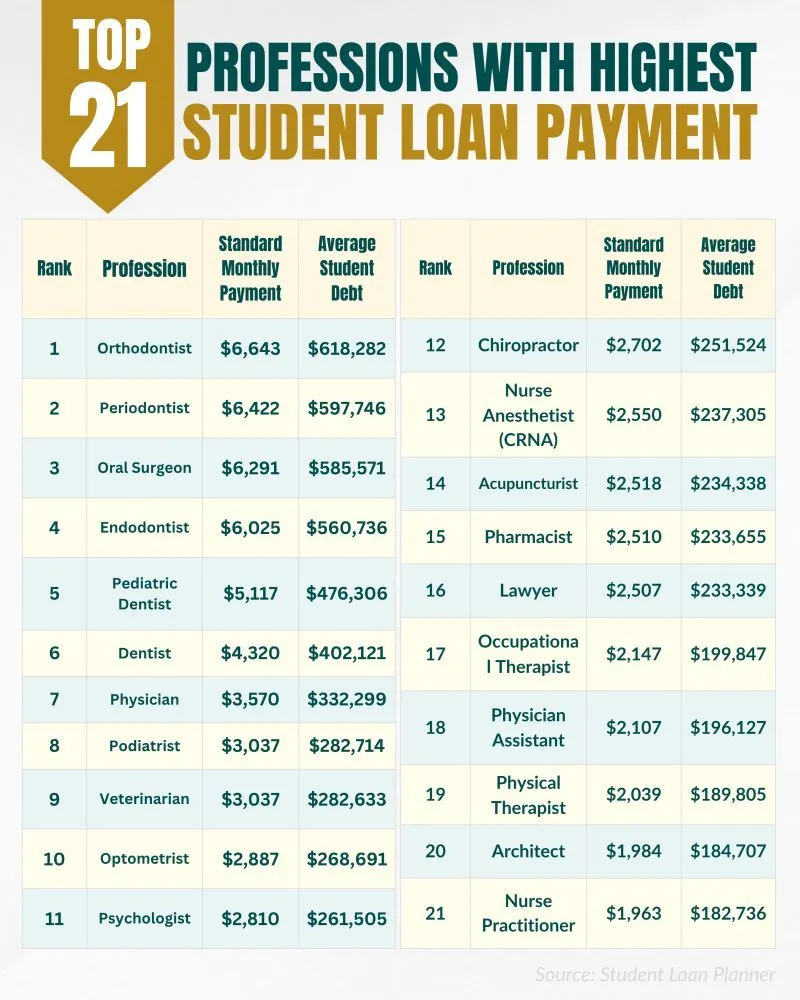
A recent infographic from Student Loan Planner highlights just how substantial that burden can become. Among the professions listed, the reported average student debt ranges from $182,736 to more than $618,000.
The numbers are striking.
Orthodontists top the list with an average reported student debt of $618,282and a standard monthly student loan payment of $6,643. Periodontists follow at $597,746, while oral surgeons average $585,571 and endodontists $560,736.
But the issue extends well beyond dentistry and medicine.
The infographic reports average student debt of:
$261,505 for psychologists
$251,524 for chiropractors
$237,305 for nurse anesthetists
$233,655 for pharmacists
$199,847 for occupational therapists
$196,127 for physician assistants
$189,805 for physical therapists
$182,736 for nurse practitioners
For occupational therapists, for example, the graphic estimates a standard monthly student loan payment of$2,147. For physical therapists, it is$2,039.
Those are not simply numbers on a spreadsheet. A student loan payment approaching $2,000—or considerably more—each month can influence where a graduate lives, what jobs they can afford to accept, whether they can purchase a home, how quickly they can build savings, and many other major life decisions.
Landmark University of Health Sciences Is Asking a Different Question
At Landmark University of Health Sciences, we believe healthcare education should prepare students to serve patients without unnecessarily burdening their financial futures.
That belief is influencing how we are building our allied health degree plans.
Instead of beginning with the assumption that becoming a healthcare professional must require years of escalating tuition and borrowing, we are working backward from a different goal:
How can we create rigorous pathways into healthcare careers while helping students minimize the time, cost, and debt required to earn their degrees, while improving training and increasing the number of employable credentials along the way?
That means affordability isn't simply a financial-aid conversation. It is part of the academic design conversation.
Designing Degree Pathways With Student Debt in Mind
Reducing student debt requires more than lowering a number on a tuition page. The total cost of earning a degree can be affected by program length, unnecessary credits, transferability, prerequisite requirements, scheduling, and the amount of time students must spend away from the workforce.
As Landmark develops allied health degree plans, our goal is to examine those factors together.
We want to build efficient, career-focused, credential-stacked academic pathways that give students the education and preparation their professions require without unnecessarily extending the journey to graduation.
Where appropriate and consistent with accreditation, licensure, certification, and academic requirements, that can mean creating clearer pathways between stages of education, recognizing applicable prior learning or transferable coursework, eliminating unnecessary duplication, and designing programs around the competencies students actually need to enter and advance in healthcare careers.
The objective isn't to make healthcare education easier.
It's to make the pathway smarter.
Affordability Is a Healthcare Workforce Issue, Too
Student debt doesn't affect graduates alone.
Healthcare organizations across the country need qualified professionals in nursing, rehabilitation, diagnostics, behavioral health, and other allied health disciplines. Yet when entering those professions requires taking on substantial debt, the educational pathway itself can become a barrier.
Creating more financially sustainable routes into healthcare therefore has implications beyond individual students.
It can help broaden access to healthcare education, create opportunities for working adults to advance professionally, and strengthen the pipeline of qualified healthcare professionals entering communities that need them.
At Landmark University of Health Sciences, we see those goals as connected.
Student opportunity, workforce development, and healthcare access can all begin with better educational pathways.
Looking Beyond the Starting Salary
Students evaluating healthcare programs are often encouraged to ask,“How much will I earn after graduation?”
That's an important question—but it shouldn't be the only one.
Students should also be able to ask:
How much will the degree cost me? How much might I need to borrow? How long will completing it take? And what could my monthly loan payment look like after graduation?
The Student Loan Planner figures illustrate why those questions matter. A profession can provide a strong income and still leave graduates managing a substantial monthly debt obligation.
We believe universities have a responsibility to consider both sides of that equation.
Building a Different Model at Landmark
Landmark University of Health Sciences is building allied health degree plans around a straightforward principle:
The education required to care for others shouldn't unnecessarily compromise a student's own financial well-being.
Our vision is to develop academically rigorous, workforce-aligned programs while keeping affordability, efficiency, and student outcomes at the center of program design.
That means looking carefully at the entire educational journey—from a student's first applicable college credit through degree completion and entry into the healthcare workforce—and asking where we can make that journey more efficient without compromising educational quality or professional standards.
The student debt statistics in this graphic demonstrate the scale of the challenge.
We believe they also demonstrate the opportunity.
Healthcare needs talented, compassionate professionals. Students need educational pathways that make those careers attainable. And higher education needs new approaches that recognize that the true value of a degree isn't simply what a graduate can earn—it is also what it costs them to get there.
At Landmark University of Health Sciences, that's the future we're working to build.
Source note: Statistics cited above are reproduced from the Student Loan Planner infographic provided with this article. Before publication, Landmark should verify the infographic's original methodology, data period, assumptions behind “standard monthly payment,” and underlying source, and describe the figures as reported estimates rather than current universal debt levels.

NAHWD — Advancing Healthcare Workforce Development

Mission-Focused
We equip healthcare providers, educators and workforce leaders with training, workforce planning, faculty and leadership development, and member resources to build a more sustainable workforce.

Workforce-Centric
Learn about membership, professional development, conferences, and data-driven workforce research.

© Copyright 2026 Site Design by Providence Brands - All Rights Reserved.